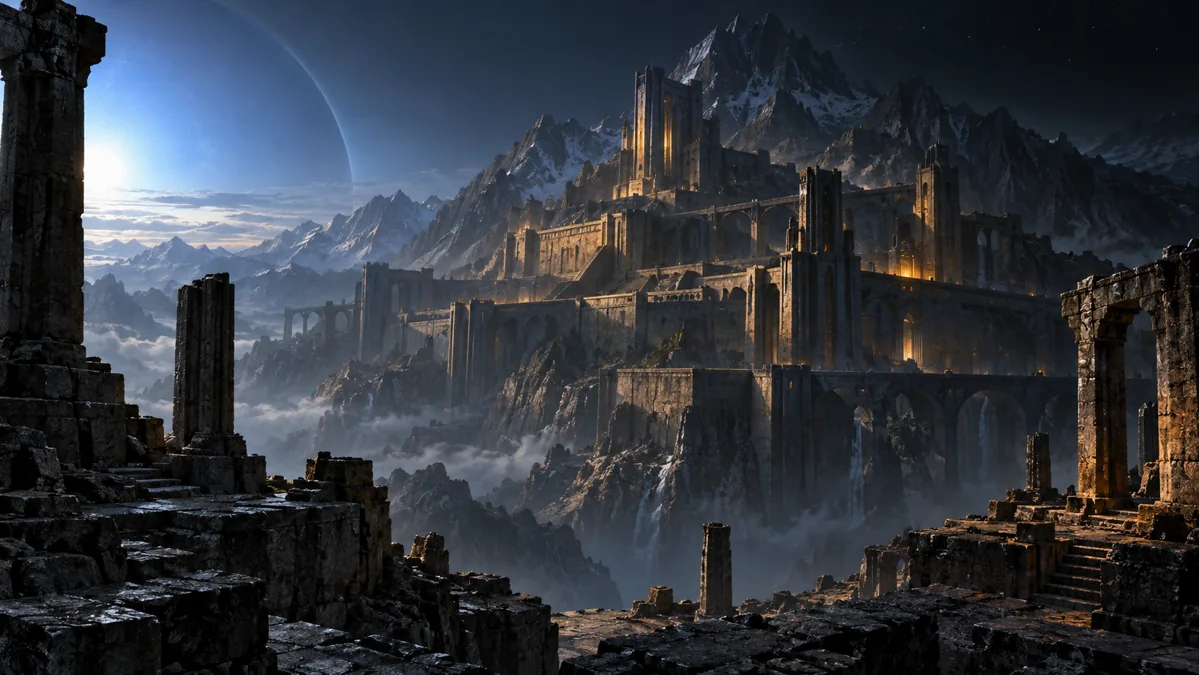
Two novels offer two different tests of Roboute Guilliman's confidence in reason, institutions, and a human future. David Annandale's Lord of Ultramar places him among the ruins of Thoas, where a victory becomes a dispute over what deserves remembrance. Dan Abnett's Know No Fear places him within the destruction of Calth, where accepted relationships and carefully organised systems become vulnerabilities. This collection reads those tests together. It is an analytical bridge, not a complete biography.
Two campaigns, one problem of seeing
On Thoas, Guilliman recognises human architecture and gives it a place in the future he intends to build. The ruins should connect new settlers to a lost civilisation. His initial reasoning has moral and cultural substance: conquest should not needlessly destroy the memory of humanity. Yet the evidence is incomplete. He has identified who built the structures before understanding what the structures represent.
On Calth, the problem takes another form. The Word Bearers gather beside the Ultramarines as expected partners. Guilliman recognises political strain and wants the conjunction to repair it. He sees a difficult relationship, but the attackers have already made that relationship a means of access. The defenders possess facts about the gathering without possessing the intention that gives those facts their deadly meaning.
Neither book treats intelligence as a guarantee of accurate interpretation. A commander can perceive many details and still fail to admit the possibility that would make them coherent. The central problem is therefore not a shortage of reasoning ability. It is the relationship between reasoning and the assumptions it is allowed to question.
Institutions have a memory
The Twenty-Second Chapter resists Guilliman's reforming appointment of Iasus. Its officers understand their specialist identity and resent the judgment implied by an outsider's elevation. Gage warns that the lawful decision can have practical costs. The Chapter's memory of itself influences how new orders will be received.
In Know No Fear, the institutional memory of fraternity makes Space Marine combat a troubling subject for study. Thiel is censured for considering it. The organisation has a way of fighting and a way of defining the people against whom fighting is legitimate. Once the Word Bearers attack, those definitions have to change under catastrophic pressure.
These situations are not identical. The Twenty-Second is not a hidden version of the traitor Legion, and the archive should not suggest that its internal conflict predicts betrayal in a literal sequence. The useful comparison is narrower: institutions carry expectations into new circumstances, and command must work with those expectations rather than assuming an order can make them disappear.
Marius Gage as a connecting voice
Gage appears in both books as a substantive participant, not merely a recurring name. On Thoas, he can warn Guilliman about morale and ask the historical question that the recovered ruins make uncomfortable. His loyalty allows him to speak, but it does not remove the difficulty of what he is saying.
On Calth, wounded and faced with ruptured command, he recognises Thiel's organised response. He must assess what can still be done with a damaged ship and surviving personnel. The connection is a practice of judgment: listen to useful knowledge, identify a sound proposal, and keep authority responsive to reality.
The practical after the theoretical fails
Thoas forces Guilliman to revise his use of the Destroyers and his understanding of the underground installation. A tool he resists at the beginning becomes appropriate to a specific problem later. The precision of the final fighting around dangerous ordnance shows force constrained by attention to consequences.
Calth demands more radical reconstruction. Thiel builds local command; Ventanus assembles a ground force; Tawren recovers technical leverage. Guilliman later invites others to share what they know. The practical no longer consists of executing the untouched opening plan. It consists of learning from people whose experience has developed inside the failure of that plan.
This makes the two-book sequence richer than a story of a great commander proving himself twice. Success depends on others who can name the problem he has not fully seen. It also depends on accepting that an achieved objective may not restore the conditions that made the original objective desirable.
The memory that remains
Erasure overturns the hoped-for heritage of Thoas. Guilliman judges the recovered civilisation as a warning he does not want future settlers to inherit. Gage's comparison with the Imperium's own military commitment makes that decision uneasy. The ending preserves Guilliman's sense that some blindness remains.
Calth's ending also refuses a clean restoration. The fleet must depart as the Ruinstorm rises, while survivors move below. Ventanus's commitment continues into the Underworld War. The epilogue gives that endurance a later memory rather than closing it with the destruction of one enemy commander.
How to read this collection
Begin with The Thoas Campaign and follow the ruins, method, Destroyers, Iasus, and Monarchia dossiers into Erasure. Then approach Calth through the world before ruin and the betrayal before the main attack. The catastrophe, Thiel, Ventanus, Kor Phaeron, Ruinstorm, and arcologies reveal different scales of the same disaster.
The timeline supplies an ordered reading path, not a claim to a complete galactic chronology. Character and faction dossiers stay within the two novels. The library identifies the books behind the analysis. The artwork offers original atmospheric interpretations and does not serve as factual evidence. These boundaries keep the archive useful: it can explain connections, disagreements, and consequences without replacing the novels or pretending to contain Guilliman's entire life.
Further reading
Read the original sources
David Annandale, Roboute Guilliman: Lord of Ultramar.
Dan Abnett, Know No Fear: The Battle of Calth.
Original summary and analysis. No book text or artwork is reproduced.