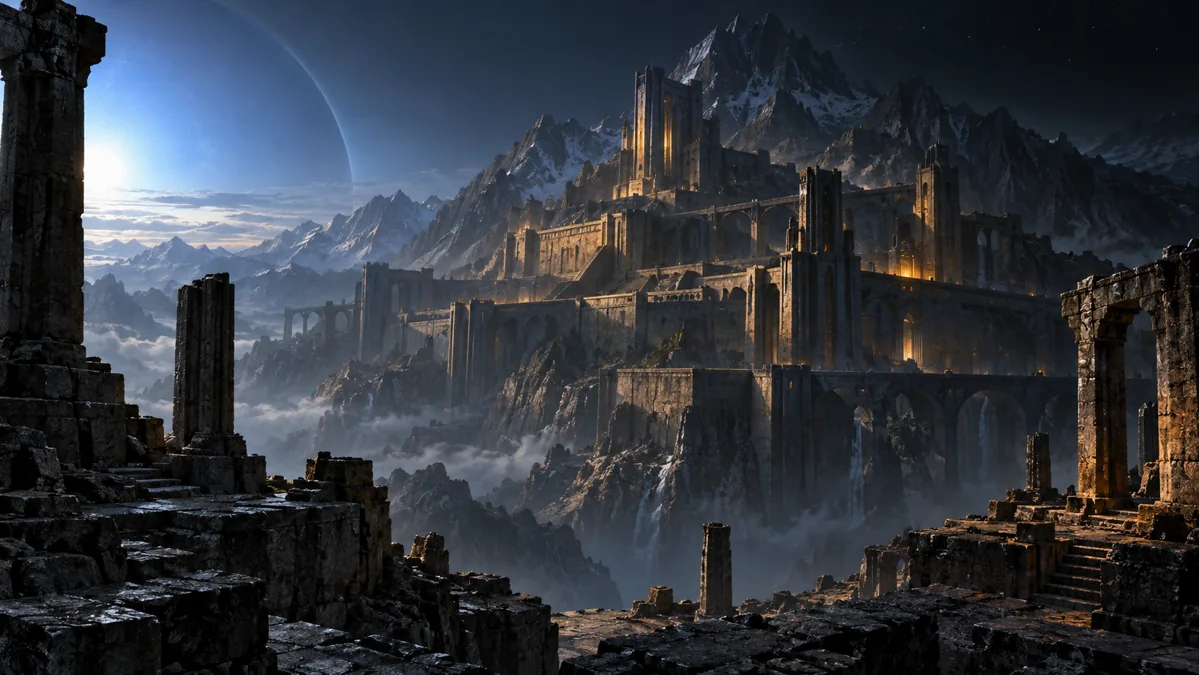
The conquest of Thoas begins with a military opportunity and a historical question. Roboute Guilliman arrives to destroy an ork power, but the enormous structures visible in the mountains suggest that another human civilisation once occupied the world. The ruins therefore matter before their purpose is understood. They give the campaign a meaning beyond eliminating an enemy: the Ultramarines might recover a lost part of humanity's story while making room for a new human settlement.
David Annandale makes this aspiration inseparable from the conduct of the war. Preservation is not a decorative interest that Guilliman can pursue after the fighting. It affects the selection of objectives, the use of destructive weapons, and the way commanders interpret his orders. Thoas becomes a test of whether a force designed to conquer can also act as a custodian. The answer changes as the army learns what it has actually entered.
A world divided by its star
Thoas is tidally locked to a blue star. One hemisphere endures permanent heat, the other permanent cold; the fleet operates above the terminator between them. This gives the initial reconnaissance a distinctive setting. The world is neither an interchangeable battlefield nor an empty surface. Its geography narrows the encounter, while the mountain ruins concentrate attention on a landscape already shaped by an unknown history.
Guilliman sends scouts to establish whether the structures are human and to investigate the orks occupying them. Confirmation of human origin strengthens his desire to preserve them. He does not know why their builders vanished. That absence creates the first interpretive risk: an impressive surviving structure can seem to demand reverence before anyone knows what it commemorates.
Command as an argument
The Twenty-Second Chapter brings a different understanding of military necessity. Hierax sees a case for using the Second Destroyers to end the infestation rapidly. Guilliman sees an unacceptable cost in the permanent destruction and contamination such a solution could leave behind. Neither position is merely aesthetic. One stresses speed and finality; the other insists that a victory should leave something worth inheriting.
The appointment of Eleon Iasus to lead the Twenty-Second adds institutional pressure to that disagreement. He is an outsider to the Chapter, while Hierax is passed over. Marius Gage warns that the choice can damage cooperation even without an openly declared refusal to obey. Guilliman's project of reforming his army is therefore running alongside his project of recovering a world. Both depend on his ability to judge people whose values differ from his own.
The battlefield beneath the battlefield
The campaign does not remain a straightforward assault across open ground. Strongpoints and pyramidal structures lead into a dense underground network. What appeared to be a set of ruins becomes a military environment with its own concealed connections. The orks' movements and the radiation associated with parts of the complex are clues to a larger problem.
Sirras's decision to continue a destructive attack against Iasus's orders shows how the command conflict becomes material. An argument about doctrine now produces physical consequences in a fragile landscape. Collapses expose more of the tunnels and alter the situation facing Guilliman. The war that he hoped to control through clear preparation demands improvisation, renewed reconnaissance, and a reconsideration of the tools he has kept in reserve.
The Destroyers eventually become participants in the solution. Their deployment does not make the earlier debate meaningless. It demonstrates that a weapon's suitability depends on the specific problem, not simply on a commander's prior dislike or a specialist formation's desire for vindication. Hierax's reading of the underground installation becomes useful precisely because he recognises what Guilliman has not yet fully understood.
A discovery that changes the victory
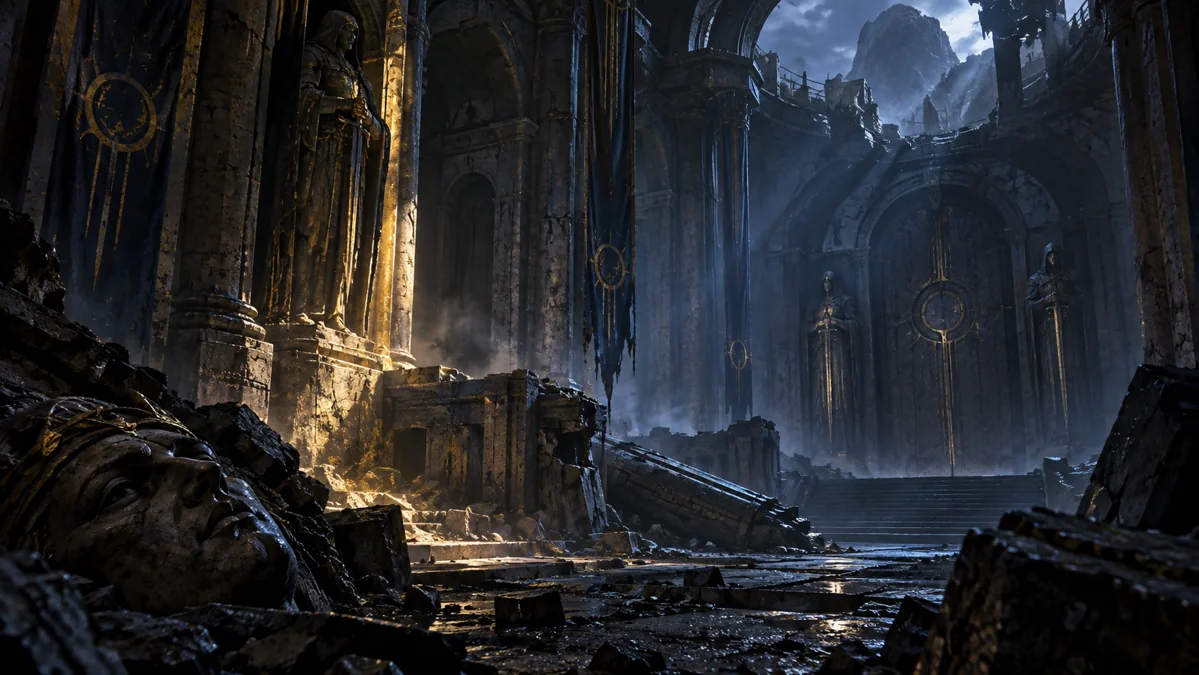
The deeper complex contains a dangerous concentration of ancient weaponry. Guilliman must fight with precision around ordnance whose destruction could release consequences beyond the immediate duel. The concluding discovery is historical as well as tactical. Evidence indicates that the former inhabitants fought a ruinous war against one another; the surviving fortress is not simply a monument to a heroic defence against outsiders.
In the epilogue, Erasure, Guilliman withdraws the value he initially assigned to preserving the site. Gage's questioning leaves a troubling comparison unresolved: what follows if a civilisation devotes too much of itself to war? The campaign has destroyed the present ork enemy, but it has not given Guilliman an uncomplicated story of human recovery.
Why the campaign matters
Thoas is most revealing when its beginning and ending remain in view together. Guilliman first sees heritage that should survive conquest. He later sees a history he wants removed from the future he intends to build. His final unease prevents that change from reading as a neat correction. The novel asks whether refusing an uncomfortable memory can itself become a form of blindness. Military victory does not settle the question of what should be remembered, or who gets to decide.
Following the evidence
The linked reading path separates the questions the campaign gradually brings together. The ruins dossier follows the changing interpretation of architecture. The Iasus and Destroyer dossiers follow how disagreements inside the army become consequences outside it. Monarchia's Shadow keeps Guilliman's remembered destruction in view without importing a separate history from other works. Erasure then returns to the question with which the fleet arrived: what will a recovered world inherit?
These connections also keep the uncertainty precise. The evidence supports a major change in Guilliman's judgment, not a complete reconstruction of every inhabitant's life on old Thoas. The ending asks the reader to examine that judgment. It does not require an archive to supply an answer the novel deliberately leaves uneasy.
Further reading
Read the original sources
David Annandale, Roboute Guilliman: Lord of Ultramar.
Original summary and analysis. No book text or artwork is reproduced.