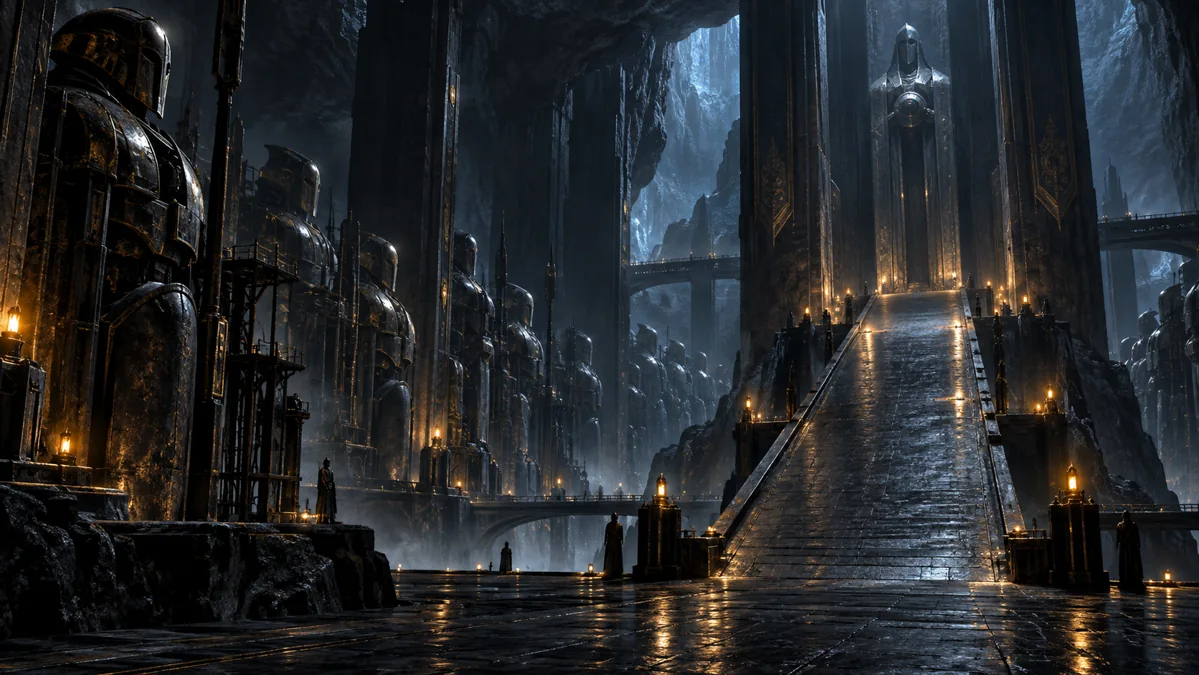
Erasure is the title of the epilogue to Lord of Ultramar and the final turn in the campaign's interpretation. The orks have been confronted and the great underground installation has yielded its secrets. What remains is not another tactical problem of the same kind. It is a question about the history Guilliman will permit the recovered world to keep.
Evidence after the fighting
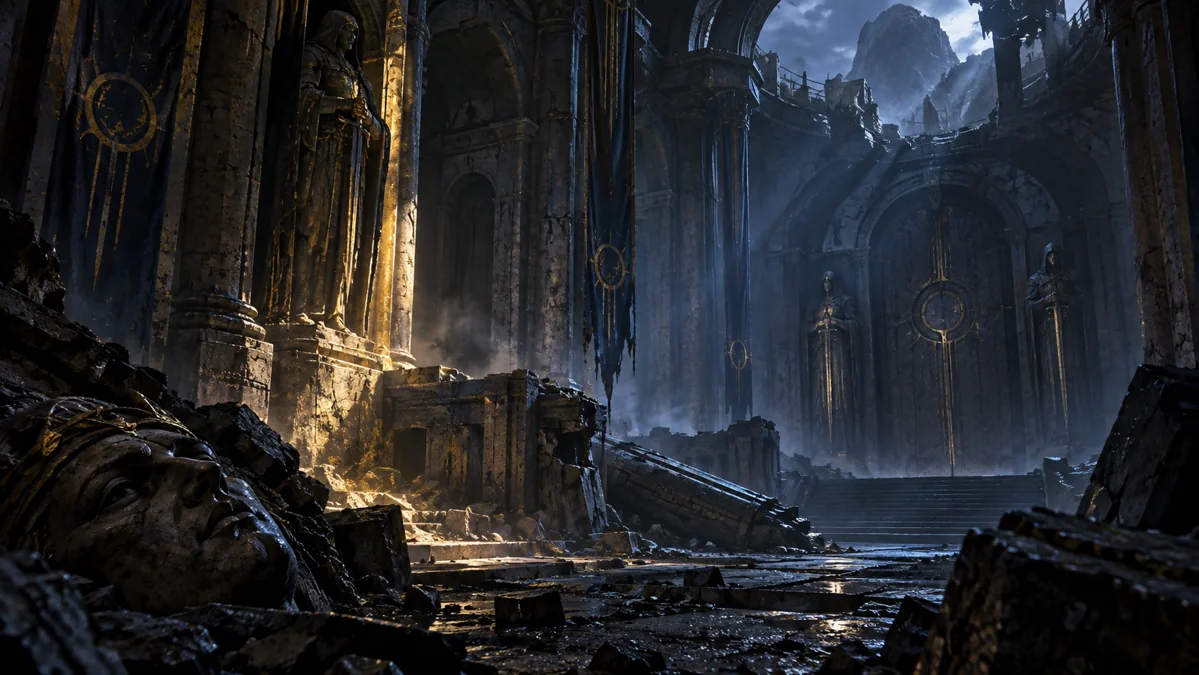
Marius Gage's troops clear a chamber beyond the main cavern and uncover an intact mural. Gage, Iasus, and Hierax wait while Guilliman studies what it represents. The setting matters: the decisive historical reading emerges from a room the current occupiers have largely neglected. The military operation has made the evidence accessible, but its meaning is not identical to the victory that exposed it.
The conclusion overturns Guilliman's initial hope. Thoas's surviving military structures and the evidence of bombardment point toward a civilisation at war with itself. The destruction was not simply the end of a heroic resistance to an external invader. The monumental fortress belongs to a history of internal violence, including the use of devastating weapons at close quarters.
What changes in Guilliman's judgment
At the beginning, preserving human history is part of the campaign's purpose. The ruins might link future settlers to a lost civilisation. Guilliman treats even dead cultures as contributors to a larger human story. By the epilogue, he no longer wants this particular story to shape the world's future.
That is a substantial reversal. An account that says only that Guilliman wanted to save ancient ruins misses the conclusion, while an account that says he simply discovers the ruins are worthless misses the value he once assigned to them. The novel's argument exists in the movement between those positions. The same leader, using the same commitment to human civilisation, arrives at opposite decisions about remembrance.
The discovery is not a complete survey of the old world. Guilliman recognises that anything outside the surviving fortress is gone. The evidence he has is powerful, but fragmentary. His judgment about the value of the whole history therefore deserves analysis as a judgment, rather than being presented as an omniscient verdict on every life that once existed there.
Gage's disturbing comparison
Gage follows the inference that a civilisation devoted entirely to war cannot sustain itself indefinitely on one planet. He then begins to relate that thought to the scale of the Imperium's own military commitment. The question moves the ruins from a failed past toward an uncomfortable mirror of the present.
This is why the epilogue does not simply close an archaeological mystery. If the old civilisation is rejected only as irrational, the observers may avoid examining the forces that could make their own society resemble it. The distance between Thoas and the Imperium becomes less reassuring than Guilliman's intended future would suggest.
Precision, contamination, and memory
The final combat has already required careful force around dangerous ordnance. Guilliman refrains from using a weapon whose effect could unleash the buried arsenal. The scene makes him a practitioner of disciplined violence, capable of recognising material limits. His historical decision asks whether he can be equally precise about the meanings attached to that violence.
Parts of the ruins are now tainted, and their permanent loss no longer troubles him as it did earlier. This change belongs to the same interpretive turn. The cost of destruction is not assessed in isolation; it changes when he changes his estimate of what is being destroyed. The archive should keep that relationship visible rather than celebrating preservation and erasure in separate compartments.
An ending with an open question
Guilliman's final unease is essential. Looking back at the weapons and the ork throne, he experiences a sense of blindness. Annandale does not end with total self-command or with a perfectly corrected theory. The primarch has learned something real and still cannot be certain that he has understood it fully.
Erasure therefore belongs at the conclusion of the Thoas reading path. It is the point where conquest, heritage, and reason become inseparable from the power to exclude a memory. The campaign can end. Its question about what a civilisation refuses to see cannot be settled so neatly.
Further reading
Read the original sources
David Annandale, Roboute Guilliman: Lord of Ultramar.
Original summary and analysis. No book text or artwork is reproduced.