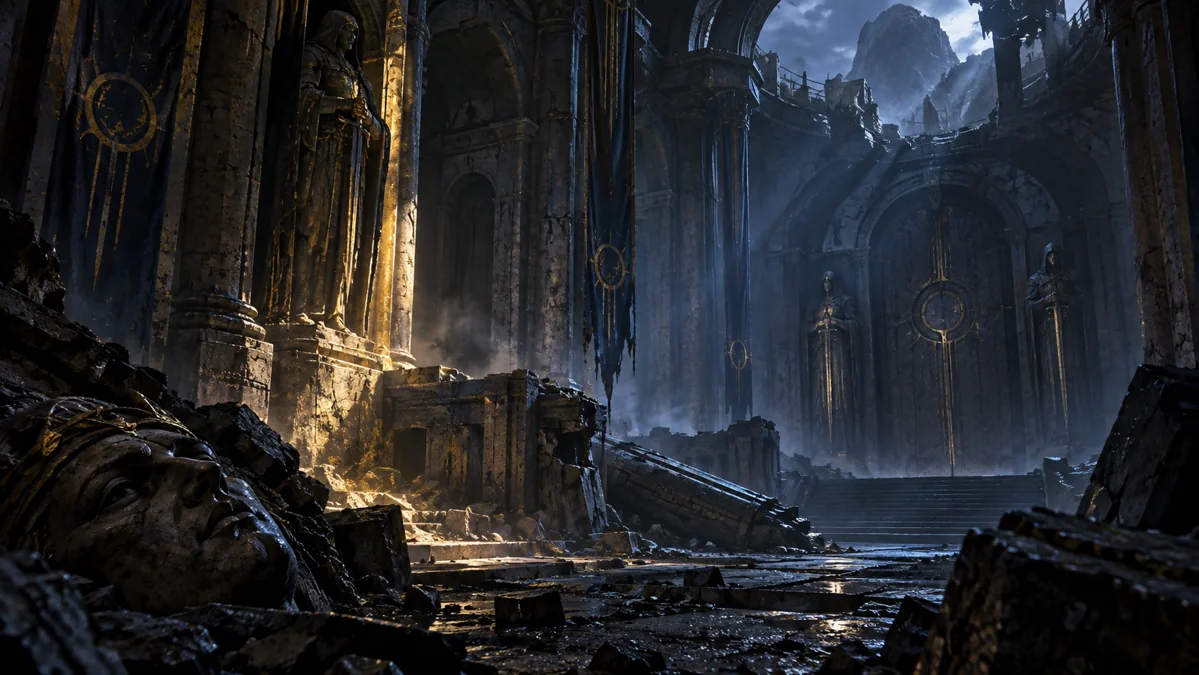
The ruins of Thoas first appear as a promise. Their scale suggests an ambitious human civilisation, and their survival offers Roboute Guilliman a possible connection between a lost past and a future settlement. Yet the novel steadily makes the structures harder to read. What matters is not simply their grandeur, but the gap between an observer's expectations and the evidence embedded in stone, tunnels, and weapons.
An architecture without its inhabitants
The early reconnaissance finds immense masonry in the mountains: damaged upper levels, great apertures open to the weather, and pillars whose scale exceeds ordinary buildings. Human origin can be confirmed more readily than human purpose. There are no living builders available to explain the place. The Ultramarines must reconstruct its meaning while fighting an enemy that has occupied and altered it.
Guilliman initially regards even a dead civilisation as part of a continuing human story. Preserving the ruins would therefore serve more than curiosity. A future population might inherit a visible past rather than occupy land stripped of memory. This is a serious civilising ambition, but it also puts pressure on the evidence. The more he wants the ruins to support that ambition, the easier it becomes to imagine a worthy history before discovering one.
Ruins as military terrain
The structures are not safely detached from the battle. They provide strongpoints, shelter, routes, and concentrations of ork activity. Preserving them shapes where the Ultramarines can apply force. A pyramid becomes both a historical object and a tactical centre; the surrounding landscape forces soldiers to interpret the same stonework as evidence and as an obstacle.
That overlap is central to the dispute over the Destroyers. Contamination and overwhelming destruction might remove an immediate threat while making the recovered ground unusable. A ruin cannot be preserved only in name if the means of taking it destroy its future value. Conversely, requiring preservation without understanding the concealed military system can expose troops to dangers that the apparent surface does not explain.
The hidden scale of the site
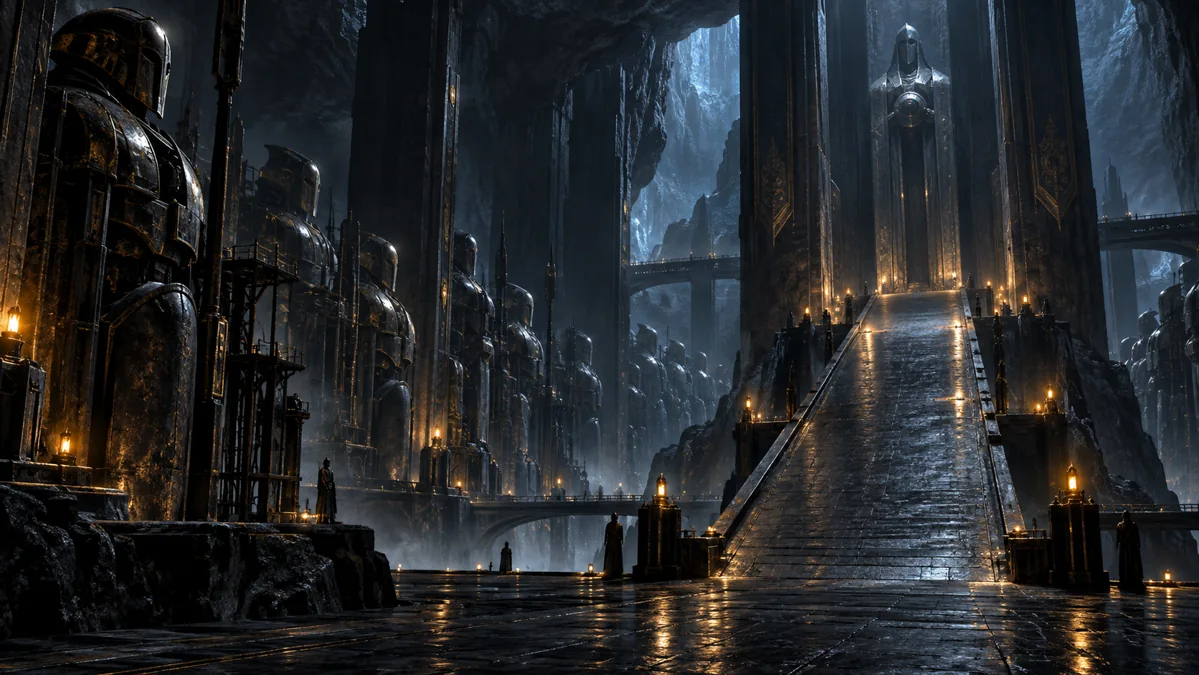
The subterranean campaign reveals that the visible structures are only part of the installation. Tunnels, ramps, chambers, and concealed connections change the interpretation of what stands above ground. Hierax's inference that the complex contains a weapons concentration follows from the military character of the network and from the clues around it. The site becomes legible through its function, rather than its grandeur alone.
The discovery also complicates the distinction between old and new violence. The orks have not created every danger the Ultramarines encounter. Ancient weapons remain capable of killing long after their original users have disappeared. Thoas's past is not inert. Its technology can still dictate how the living must fight, including Guilliman's need to avoid striking certain ordnance with his power gauntlet.
The mural and the reversal
In Erasure, the cleared chamber provides evidence that changes Guilliman's historical reading. The civilisation's surviving military works point toward internal warfare and self-destruction. The ruins no longer represent the heroic human resistance he had hoped to recover. Their enormity becomes an index of resources committed to a fatal conflict.
This does not justify claiming that the novel gives a complete history of Thoas. The Ultramarines have found fragments and make an interpretation from them. The ending's force lies partly in the fact that Guilliman moves from uncertainty to a severe judgment while important questions remain. The account of what happened is strong enough to disturb him, but it does not remove the problem of how a victor selects the history a future population will receive.
A place that resists a clean caption
An archive should resist reducing Thoas to either a beautiful monument or a worthless mistake. The novel contains the movement between those judgments. Gage's concern about a society consumed by military expenditure creates a further echo: the ruins may reveal something unsettling about the observers themselves.
The final image of Guilliman's unease keeps the site open to analysis. Recovering evidence is not the same as becoming comfortable with it. Thoas matters as a landscape where heritage, military necessity, and ideological confidence collide. Its deepest threat is not merely a buried weapon, but a history that refuses to confirm the story Guilliman wanted to tell.
Further reading
Read the original sources
David Annandale, Roboute Guilliman: Lord of Ultramar.
Original summary and analysis. No book text or artwork is reproduced.