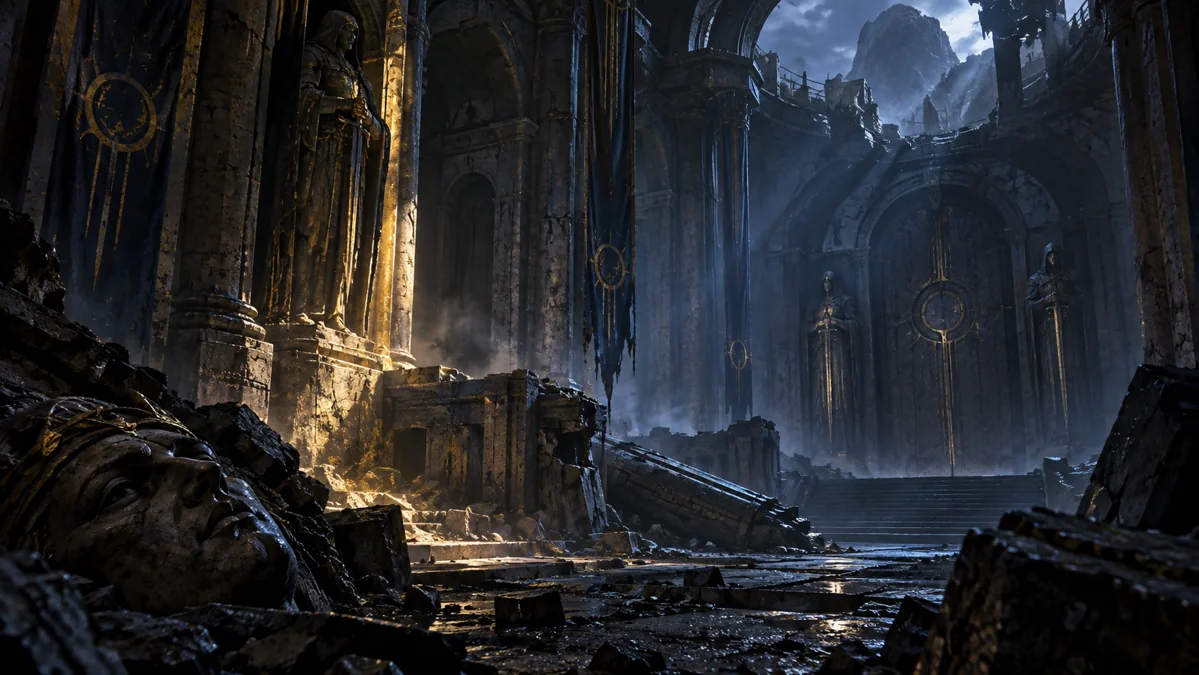
Monarchia enters Lord of Ultramar as a memory that shapes Guilliman's expectations of another cityscape. This article follows that memory as Annandale presents it. It does not reconstruct the wider event from other books or expand it into an independent history. What matters here is the way a past act of destruction changes the meaning Guilliman assigns to the ruins before him.
The remembered city
In his conversation with Marius Gage, Guilliman recalls a city built to glorify an Emperor it treated as divine. The Ultramarines removed its population and destroyed it. The remembered beauty of Monarchia does not disappear under the official reason for its punishment. Guilliman understands that its inhabitants had been loyal, and that the belief for which they suffered had been taught to them.
The recollection is therefore uneasy. A military force carried out an authorised destruction, but authorisation does not make the result emotionally or culturally simple. The lost city stands beside the primarch's wish to build an enduring human civilisation. Its disappearance creates a contradiction he cannot resolve merely by describing it as a necessary act.
Thoas as a possible answer
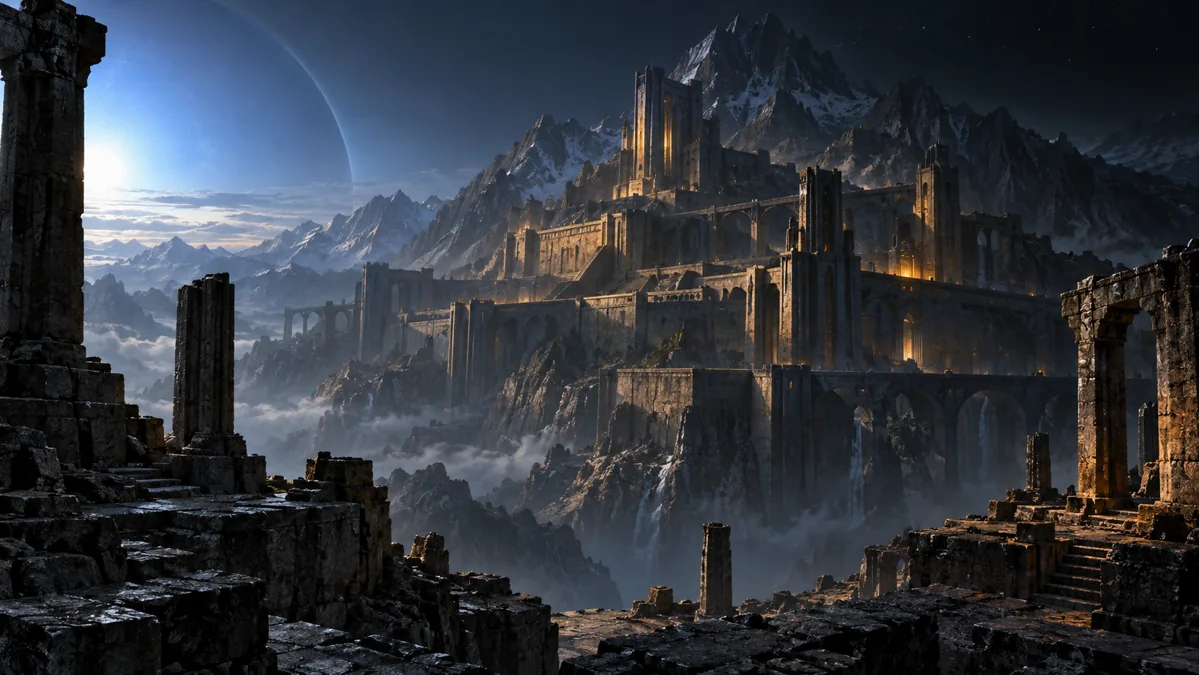
The human ruins on Thoas offer another relationship to a city. Instead of making architecture vanish, the Ultramarines might preserve it while taking the world from its present ork occupiers. Future settlers could recover a connection to an older human population. Gage recognises the appeal of becoming creators again after the bitterness of Monarchia.
This link does not mean Guilliman's preservation policy is insincere. His discussion of remembrancers and the human story supplies a genuine cultural argument. Yet the memory makes the decision more than a neutral assessment of archaeological value. The ruins are asked to carry a symbolic burden: they might demonstrate that his Legion can recover and rebuild as well as punish and erase.
Symbolism meets an actual campaign
The difficulty is that Thoas is not waiting passively to fulfil that purpose. Its ruins contain orks, concealed routes, radiation, and ancient weaponry. The historical object and the tactical obstacle are the same place. Preserving a meaningful past can become a constraint on soldiers who need to understand the dangers immediately in front of them.
The Destroyer dispute makes that constraint explicit. Hierax offers a swift annihilating solution. Guilliman rejects the devastation it would leave. The argument is shaped by competing ideas of victory, but Monarchia adds an emotional horizon to Guilliman's position. Another lost human site would not be an abstract entry in an inventory; it would repeat a kind of destruction already lodged in his memory.
The reversal of the hoped-for story
Erasure denies Guilliman the history he hoped to recover. The surviving evidence points to human self-destruction rather than a heroic last defence against outsiders. The ruins' military character makes their grandeur troubling. They become the remains of a civilisation whose resources and energies were consumed by its own war.
Guilliman changes his view of what future settlers should inherit. This creates a sharp narrative movement: a campaign partly framed as recovery ends with a refusal of the recovered memory. The result is not a second version of Monarchia in every factual respect. The relevant comparison is the decision to erase a human place or its meaning when that meaning becomes incompatible with the future being built.
Memory and the limits of correction
The novel's later journal reflection connects blindness and missed inferences to the consequences of Monarchia, but it does not license an archive to fill every gap with unrelated canon. The secure claim is narrower and more revealing: Guilliman knows that having evidence and possessing a method are not always enough to recognise what matters.
Gage's final concern about a civilisation devoted to war makes that problem immediate at Thoas. A recovered past can become a warning about the present. Guilliman's reluctance to carry its memory forward may therefore protect a future settlement while also refusing a disturbing comparison. The ending preserves the discomfort. Monarchia's shadow does not vanish simply because the next campaign begins with better intentions.
Further reading
Read the original sources
David Annandale, Roboute Guilliman: Lord of Ultramar.
Original summary and analysis. No book text or artwork is reproduced.