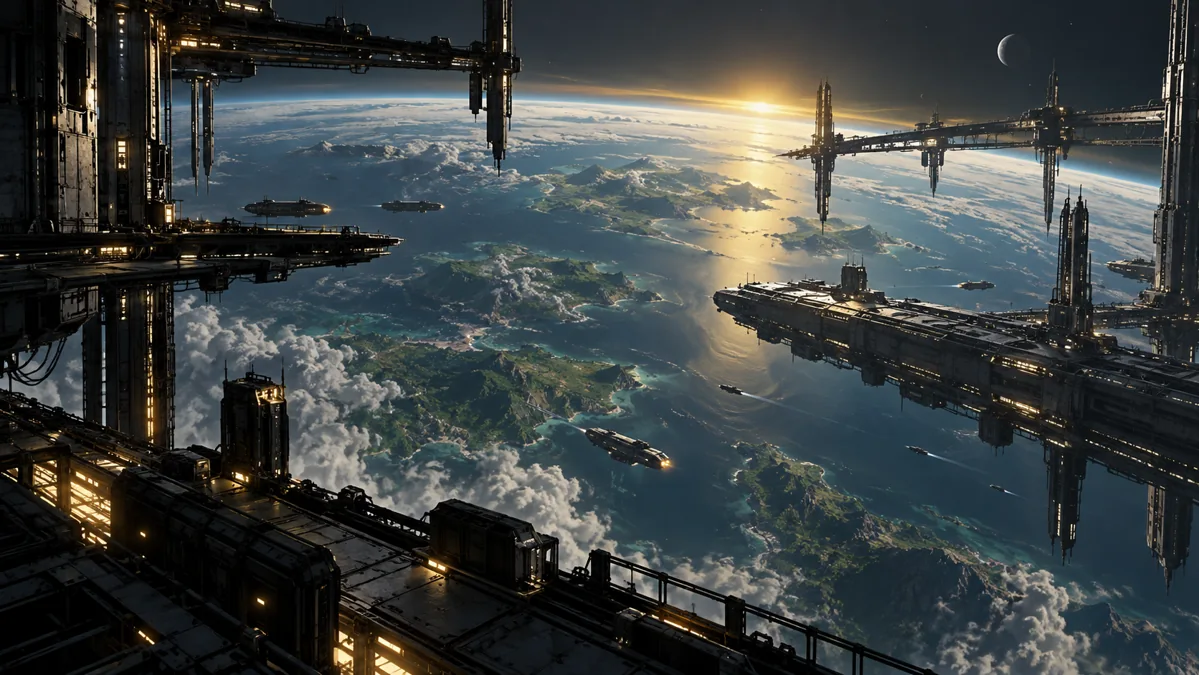
Know No Fear gives Calth a life before it gives it a catastrophe. The opening material follows military preparation, local movement, work, weather, relationships, and the practical business of assembling forces. These details are not pauses before the important story. They establish what destruction means when it reaches a world already full of people and connected systems.
A gathering designed for cooperation
The Ultramarines and Word Bearers are expected to operate together. Guilliman understands the conjunction as a political act as well as a military one: it should repair a weakness between the Legions. He recognises that the relationship is sensitive, but he does not initially interpret the gathering as an enemy formation entering his system.
This distinction matters. Calth's defenders do not fail simply because they have no preparations. They have extensive preparations for a different operation. Ships, troops, material, and command arrangements are organised around cooperation. The betrayers exploit the specific order that already exists, rather than meeting an army in a neutral space.
The world at ground level
The early surface scenes give the muster a human scale. Soldiers wait for transport, discuss the expected campaign, and negotiate the restrictions of duty against personal wishes. An estuary wind, a delayed lift, and the lights around a fortalice situate the gathering in a lived environment. The war has not yet swallowed every ordinary concern.
Abnett's attention to such details changes how later casualties are read. Infrastructure is not merely a target list. A road carries people somewhere; a port connects work to supply; a communications system coordinates relationships as well as formations. When those structures fail, the loss includes the ordinary future their users expected to have.
The presence of Titans and great military concentrations also makes the apparent security persuasive. Scale looks like strength. Yet proximity can magnify vulnerability when an attack is designed to strike from inside an accepted arrangement. Calth's crowded preparation becomes part of the attacker's opportunity.

A protective environment with hidden importance
The planet's underground spaces later become essential, but their existence is not introduced as a miraculous solution. The novel explains that natural caverns are being developed as habitats and can shelter people during periods of heightened solar activity. Some branches also connect important surface locations.
That pre-existing function is significant. The arcologies are part of the world before they become the survivors' refuge. The later withdrawal changes their scale of importance: a protective feature of life on Calth becomes the place where life and resistance can continue after the surface is lost.
Trust as infrastructure
The most dangerous system on Calth may be the shared expectation that the Legions remain brothers. Honorius Luciel's relationship with Sorot Tchure makes that expectation intimate. Guilliman's attempt to repair the relationship makes it institutional. Both kinds of trust permit close contact that would be managed differently in the presence of an acknowledged enemy.
Thiel stands at the edge of this confidence. His consideration of Space Marine combat is treated as a matter for censure. The problem is not that the Legion has forgotten how to fight, but that it has placed a particular kind of opponent outside its acceptable planning. Calth's peaceful expectation depends on a boundary the Word Bearers have already crossed.
Why the before matters
An archive that begins only with explosions loses the mechanism and the cost of the betrayal. The opening world shows how the attack gains access, why warnings are difficult to interpret, and what survivors are trying to preserve. Its calm is not a false scene inserted to surprise a reader; it is the reality that most participants inhabit until violence displaces it.
Reading Calth before ruin also guards against a purely military inventory of losses. The catastrophe damages a world, not just a deployment. The later ground struggle, technical recovery, and movement below all grow from the people and systems established here. Their endurance has meaning because the novel first gives them somewhere to belong.
Further reading
Read the original sources
Dan Abnett, Know No Fear: The Battle of Calth.
Original summary and analysis. No book text or artwork is reproduced.